
For years, businesses have been leveraging technology for handling customers on the phone. First came rigid phone menus, followed by automated responses and natural conversations. Each step made voice interactions easier to manage, but they remained largely separate from the rest of the customer experience.
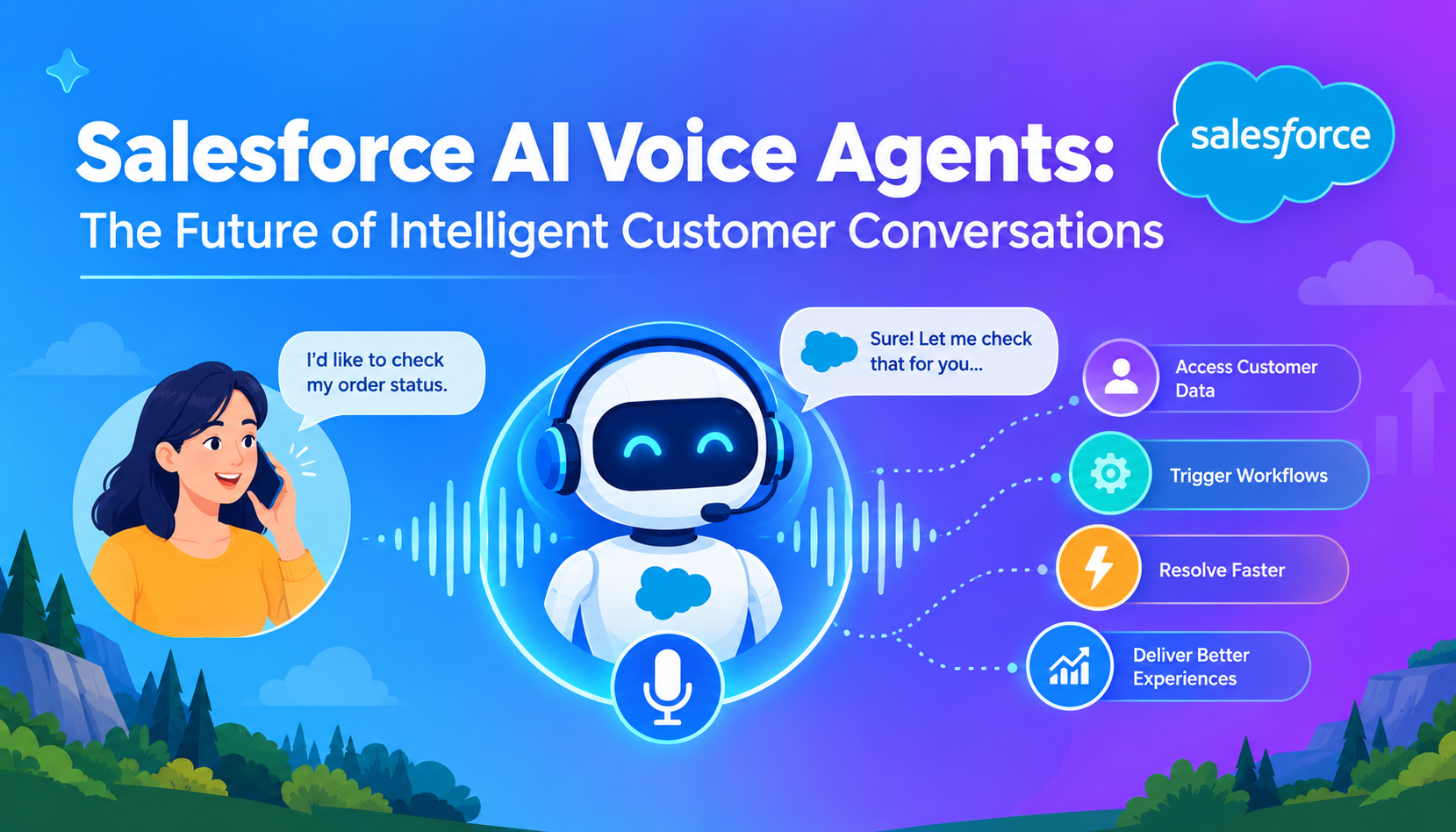
The next shift is not simply about making AI sound more human — it is about giving voice interactions enough context to understand why a customer is calling, what has happened before, and what should happen next.
For businesses already managing customer, sales, and service information in Salesforce, this creates an opportunity to connect voice with the wider customer journey. A Salesforce AI Voice Agent can bring that contextual knowledge into real-time interactions.
As voice AI continues to evolve — the real challenge lies in determining how customer conversations will be shaped when AI will be able to do more than just talk.
From Automated Calls to Intelligent Customer Conversations
The value of voice AI is moving beyond simply answering a customer’s question. An automated voice agent can follow instructions and handle routine requests — while newer systems can interpret intent, use conversation context, and respond according to what the customer actually needs.
That makes voice more than a channel for communication. It can become an active part of the customer journey—helping resolve requests, trigger actions, and involve a human when the conversation requires deeper attention.
This shift is shaping the next generation of AI voice agents.
5 Trends Shaping the Future of AI Voice Agents
The future of voice AI technology is not about facilitating the conversation but making it work. There are various reasons why voice agents are driven towards becoming something more than simple call handlers.
- Contextual Conversations
Voice agents do not remain limited to the question-and-answer model anymore. Through the context-based understanding of conversations—based on past and current data, preferences, etc. They can give more appropriate responses rather than viewing each call as an individual event.
This shift also means voice agents can become more relevant to the situation rather than simply accurate in their responses. A single question can be answered in many ways based on the account of the consumer, prior interactions, or present request. The context enables the interaction to shift from answering in generic ways to answering specifically for the consumer and the situation.
- Voice Agents Progress from Responding to Acting on Their Own
The ability to understand a request is merely a part of its benefit. Additionally, voicebots are capable of extending the conversation further by setting up appointments, modifying information, qualifying leads, or even starting workflows automatically.
This ability to act is essential since the value of a voice interaction is defined by what follows once the customer talks. Accomplishing something during the dialogue can reduce subsequent actions for both the customer and the business. Instead of creating another follow-up activity for an employee, the voice agent can help move the request through the appropriate workflow.
- Multilingual Voicebots Provide Access to Automated Customer Service
Not being able to speak a language is not an issue in automated customer service anymore — all thanks to multilingual voicebots. Businesses can now communicate with their customers in multiple languages.
It is even more convenient for companies dealing with regional customers — since they do not have to develop a separate process for each language. The key point is not to add more languages to the list — but rather to reach a wider audience without compromising the level of service quality.
- Voice Will Be Incorporated into the Overall AI Ecosystem
Voice won’t operate separately any longer but will be integrated into the whole AI system because businesses will be starting to integrate voice automation platform into CRM, service, messaging, analytics, and other AI software because they’ll perceive voice communication as only part of a greater picture.
This broader integration also changes the role of voice within the business. Rather than operating as an independent channel, voice can become one interaction layer within a connected technology environment. Customer information, conversations, workflows, and analytics can work together instead of remaining separated across different systems.
- Human-AI Collaboration in Complicated Conversations
The system does not have to address every conversation from start to finish. It’s best to treat complicated, emotional, and meaningful conversations with a collaborative approach wherein the AI takes care of all repetitive aspects and data collection, and the humans get into action where experience and empathy are needed.
This method also acknowledges that not every single customer conversation needs equal levels of automation. While the AI handles the repetitive aspects of a conversation — the employee can intervene where the decision needs human intuition, negotiation, and a personalized touch. This is why the aim should not be for the machine to replace humans at every point of conversation.
Why Salesforce Matters in the Future of Voice AI
Voice technology becomes even more useful in cases where it can leverage the existing customer context that the team has. That being said, Salesforce is an ideal CRM, as it can provide necessary information like customer history, customer accounts, services, and sales information to the voice AI agent.
The most significant aspect of voice technology is not the integration of a phone call into a CRM system. The real breakthrough here is the connection of what the customer says with what the company already knows about the customer — and using that context to determine what should happen next.
In this sense, Salesforce is one of the major players in this revolution. This also changes how a voice interaction can fit into an existing customer journey. A caller may be asking about an open service issue — following up on a sales conversation or trying to schedule an appointment.
With the relevant Salesforce context available, the voice agent can understand that interaction in relation to what has already happened rather than treating it as an isolated call.
The same connection can also extend beyond the conversation itself. Information gathered during a call can be used to update customer records, trigger a workflow, or support the next step in the process. Voice therefore — becomes another way for customers to interact with the business while remaining connected to the systems that manage the broader relationship.
What Businesses Need to Get Right Before Adopting AI Voice Agents
A more capable voice of AI does not automatically translate into better customer conversations. The quality of the experience depends on — what the voice agent can access — what it is allowed to do, and how the business manages situations it cannot handle.
- Start with the customer context
The use of the AI voice agent is enhanced when it can operate with contextual information rather than seeing every customer call as a new process. The history, account information, past requests, and current cases will provide context for the purpose of the call.
- Define what actions the agent can perform
It’s not necessary to automate all processes equally. Organizations must decide what tasks can be performed by the AI voice agent alone, what tasks require confirmation, and what tasks should always be forwarded to employees.
- Design the human handoff
Escalation should not mean transferring a caller and starting the conversation again. When a human becomes involved, the relevant conversation history, customer information, and actions already taken should move with the interaction.
- Build for monitoring and improvement
Voice AI must also be seen in terms of its evolutionary process. Organizations require visibility of their conversations, results, failures, escalations, and other data points that can signal areas for improving their experience.
The significance of these factors is that the evolution of a Salesforce AI voice agent will not only mean that organizations have an AI that can speak. It is about creating an interaction layer that can operate reliably within the business processes surrounding the customer.
Another significant factor that needs to be taken into account here is the quality of data and its accessibility in this case. If there is any issue with either the incompleteness, obsolescence or availability of customer data, even the most advanced voice technology might not be able to offer any relevant answer to the user. Hence, it is crucial to take into account not just what capabilities AI technologies possess, but also what kind of systems allow for proper data delivery.
This also applies to control and governance in this regard. With more actions that a voice agent will be able to perform, it is vital to set certain boundaries regarding data access, customer data, approvals, and escalations.
What Businesses Can Expect from Next-Gen AI Voice Agents
As voice AI becomes more capable — businesses can expect customer interactions to become more responsive, contextual, and connected to the systems behind them. The focus will gradually move from handling calls efficiently to delivering a more complete experience around each conversation.
For AI voice agent services for businesses, this means capabilities such as:
- More natural conversations: Better turn-taking, understanding of intent, and responses that feel less scripted.
- Contextual understanding: Leveraging customer and business data to increase relevance in communications.
- Action-based automation: Expanding from question answering to task completion and workflow triggering.
- Language independence: Supporting multilingual customers without developing language-specific voice experiences.
- Smarter human handoffs: Passing conversations with employees with the relevant context — instead of starting over.
- Analytics and control: Providing more visibility to companies into the conversation, outcomes, security, and compliance.
The result is a voice experience that not only answers customer questions but also helps to take the conversation towards some kind of result.
These abilities are transforming expectations regarding AI voice agent services for businesses. Voice technology is progressing to the point where it does more than handle phone calls; it manages conversations based on customer data and the business process and next step. It’s not just about the efficiency of the call anymore, but about the effectiveness of the interaction.
How do AI Voice Assistants Fit into the Customer Experience in 2026 and Beyond?
AI voice assistants are no longer just a stand-alone solution for handling calls — instead, they have become part of a broader customer journey process where one interaction can be linked to data and processes from the CRM, messaging, and other customer contact points.
This means that the customer journey experience becomes more integrated, where interactions become relevant to the next action, including request resolution, information updates, appointment scheduling, and routing to a live representative.
The distinction becomes clearer when a customer moves across multiple touchpoints. A conversation which begins with a telephone call can result in the modification of a customer’s record, a follow-up message, scheduling an appointment, or transferring the customer to an employee. Rather than treating each individual transaction independently, AI technology can be used to link them together in such a way that the customer will not need to go through the same process again.
Herein lies the opportunity to integrate voice into the wider customer experience. The dialogues can serve as context for future actions, while the data gathered from the dialogue will help guide the customer through their experience.
The Bottom Line
The future of AI voice agents is moving beyond simply making automated conversations sound natural. With context-aware, action-driven, multilingual, and integrated voice technologies, voice technologies are becoming increasingly important in shaping the customer experience.
For the Salesforce platform, this is a chance to tie customer interactions with the knowledge and workflows that Salesforce customers already have in place through an AI voice agent platform. The real value lies not in AI being able to talk — but in understanding the conversation, using the correct context, and driving the process further.
For businesses, this evolution also changes the role of voice within their technology strategy. An AI voice agent can become a connected part of the customer experience, working with existing data and workflows instead of operating as an isolated calling tool. As these capabilities continue to develop, the distinction between voice, CRM, automation, and customer service will become less defined as customer expectations continue to evolve.


